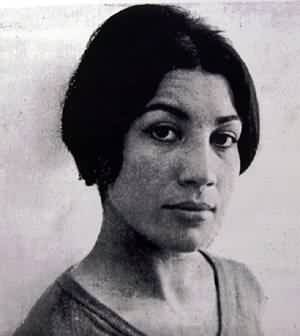
Saturday, 17 May 2008

Sin by Forough Farrokhzad (فروغ فرخزاد) / Persian poetry

I have sinned a rapturous sin
in a warm enflamed embrace,
sinned in a pair of vindictive arms,
arms violent and ablaze.

In that quiet vacant dark
I looked into his mystic eyes,
found such longing that my heart
fluttered impatient in my breast.

In that quiet vacant dark
I sat beside him punch-drunk,
his lips released desire on mine,
grief unclenched my crazy heart.

I poured in his ears lyrics of love:
O my life, my love it's you I want.
Life-giving arms, it's you I crave.
Crazed lover, for you I thirst.


Lust enflamed his eyes,
red wine trembled in the cup,
my body, naked and drunk,
quivered softly on his breast.

I have sinned a rapturous sin
beside a body quivering and spent,
I do not know what I did O God,
in that quiet vacant dark.

Original published in Deevar (The Wall). This translation comes from Sholeh Wolpé's Sin. Amazon has a whole bunch of Forough Farrokhzad poetry collections in translation.

Persian poetry in English / Forough Farrokhzad

"Why are you wasting your time on that whore?" is the question poet and translator Sholeh Wolpé kept being asked when talking about her book of Forough Farrokhzad poems. And it's 40 years since Forough died, so that's a powerful legacy.

Forough Farrokhzad (Persian: فروغ فرخزاد) wrote provocative poetry, full of challenge, defiance, taboo-breaking and lived her life in the same way. Her short life was a whirlwind of scandal (sometimes self-created, sometimes not), rejection by the male-dominated publishing and poetry/arts establishment, but also devotion from Iranians. Always an outsider and, given Iran's reactionary turn since the ousting of the Shah, guaranteed to stay that way. But that doesn't mean that Iranian's don't read her poetry or take it into their hearts.

A selected works in English and in Persian is available online. I'm going to post up several of her poems. YouTube has some videos about her and of people reading her poems (and more and more).

Friday, 9 May 2008

No talent not wanted in Bahrain

Islamists in Bahrain aren't happy that Haifa Wehbe has a concert there. But not because she's got no real talent and her songs are rubbish.

Wednesday, 30 April 2008

Religious conversion

If you float around on YouTube for long enough, you'll find videos of anything. Here are three showing people converting to and from different religions.

Converting to Judaism

From non-practicing Judaism to Hasidic Judaism...

Conversion from Judaism to Islam

Conversion from Christianity to Islam

Conversion from Islam to Christianity

Monday, 28 April 2008

The truth is, there are many Islams

Islam, like Christianity, is a religion beset with internal conflicts. Just as there are many interpretations of Christianity with emphasis on different parts of a shared history and a history of conflict, denunciation, accusations of heresy, reformations and counter-reformations, so too with Islam. Accusations of shirk and massacres of co-religionists are, sadly, not confined to just Wahhabists. There are those that see the current rise in terrorism carried out by Muslims are a sign, not of conflict between East and West but a war within Islam between absolutists and those who seek, respect and wish to save a pluralist religious community.

Ed Hussein, author of The Islamist, shines some light on this:

Islam is not a monolithic entity. Inherent within Muslim tradition is a plurality of thought, practice and reasoning that can help create a genuine Muslim renaissance or tajdid in Arabic. Just as scriptural references to stoning and flogging are cited by countries such as Saudi Arabia as justification for their horrid practices, in these same texts, we find that the Prophet Muhammad reprimanded his followers for stoning a person who attempted to flee. He also condemned those who killed innocent people. By drawing on these lessons, mainstream Muslims must illustrate that compassion, humanity and sense should override scriptural rigidity understood with anger and revenge.

Sunday, 6 April 2008

Life goes on in Tehran

Life goes on in Tehran is a monthly photo-essay from an Iranian-American working in Tehran. The start of each month sees the author/photographer uploading 20-30 new photos, taken on either a camera phone or digital SLR camera. He seems to capture the mundane and the marvelous, the peculiar and day to day lives of the people he meets.

Being an Iranian-American he's both and insider and an outsider. This shows through in his insights and the oddness and beauty he stumbles upon. Sometimes it comes in the form of high-heeled shoes, apartment blocks, posters, Iranian TV, food, Christmas in Tehran and more.

This really is one of my favourite websites about Iran. It's not treating the country as a theocratic freakshow like some blogs do, but it doesn't try to sidestep "the issues" when they stumble into the photographer's viewfinder. If you've never seen it before, you're lucky. It's been going for over 12 months now, so you've got loads of photos and stories to work through. It's something to look forward to each month.

www.lifegoesonintehran.com

Thursday, 14 February 2008

Learning a little more about Syria

My wise Syrian friend made me laugh as we picked over some (surprisingly cold) lentil kibbeh. He couldn't get his head around wanting to find the best Bashar al-Assad, Ba'athist and Pan-Arabist kitsch (posters, keyrings, flags, silhouette car stickers). The sticker shop next door to the Young Pioneers shop just off Hamidiya Souq has stickers and posters, but there's nothing spectacularly kitsch.

I had always assumed the crackdown on the Damascus Spring was a sign of al-Assad's early days, or weakness, in relation to more established members of the Syrian government. My friend set me straight on this. Bashar al-Assad had 6 years after Basel died to prepare himself for running Syria. He didn't come into control of the Syrian government in a weak position. He was in control and in power before he was President.

But why Bashar's recent obsession with all things Arabic? Why give speeches about the importance of Arabic, pass legislation to ensure children are given Arabic names, etc?

"Nasser," said my friend, "He's modeling himself on Nasser."

Saturday, 5 January 2008

Review of Danny Postel's Reading Legitimation Crisis in Tehran: Iran and the future of liberalism

Reading Legitimation Crisis in Tehran: Iran and the future of liberalism is a short essay by Danny Postel (senior editor of openDemocracy). It focuses on the failure of liberals in the US and Europe to act in solidarity with Iranian liberals, trade unionists, human rights groups and feminists in the way they did with Central America in the 1980s, explores the way liberal ideas and philosophers have impacted Iranian political discourse, explains how and why Foucault mis-read the revolution and ends with an interview with Ramin Jahanbegloo. Always interesting to see what academics from inside Iran think, but something about Jahanbegloo's confidence about liberals and liberal activism doesn't quite sit right. He's very dismissive of Iranian socialists:

DP: Why, in your view, are Iranian intellectuals and students not generally attracted to Marxist thinkers and ideas? Why do you think they tend not to be engaged by political currents like the anti-globalisation movement or anti-imperialism?

RJ: It is not necessary to explore very far to find the reason for this lack of attraction to Marxism in Iran today. In Iran the number of "Marxists" was always a hundred times greater than the number of people who had actually read and studied Marx. This is the main reason why Iranian Marxism had so much trouble making sense of the Iranian Revolution. The Tudeh Party and the leftist groups have no explanation today of their political and ideological struggles against liberal and democratic ideas in Iran. Most of these Marxist groups supported the anti-democratic measures taken against women and against Iranian liberals... I ask you the question: what do you think is left of the Left in Iran? Nothing!

The major Iranian left-wing, socialist and Marxist parties from before the Iranian Revolution may have almost zero presence and no support inside Iran, but Iranian socialists and trade unionists are still raising their voices. Iranian trade unionists trying to establish independent unions are routinely harassed by the government. During the recent student protests the slogans are those of left-wing and liberal ideas.

I fear that Jahanbegloo's "intellectuals" are not very representative of all Iranian students or the Iranian population as a whole. How many Iranians are actually reading Arendt, Habermas, etc? Jahanbegloo says young Iranians are no longer drawn to "utopian ideas". But the demands socialists in Iran are making are concrete, urgent and realistic. There's nothing utopian in asking for women's rights, an end to political repression, extra-judicial killings, goon squads harassing union activists and students or for free speech.

Postel's book doesn't address the nature of support for the government and Islamic Republic within Iran. With 17 million votes in the last presidential election, Ahmadinejad must have some supporters. Whether they're members of the industrial, city-dwelling working-class, Basij, peasant saffron-pickers getting a pay rise, middle-class bureaucrats, revolution-era religious true-believers or clerics - Postel and Jahanbegloo never really explain it. Without that clarity - without an understanding of the cultural, political, economic and religious support for the Islamic Republic - how does Postel think Americans and Europeans can overcome the cultural and language barriers and understand how they can act in solidarity and with whom?

Friday, 7 December 2007

Review of Hidden Iran by Ray Takeyh

Ray Takeyh's Hidden Iran is both a trainspotters guide to the Islamic Republic of Iran's different factions and an exposition of Iran's foreign policy. It contains a plea for the United States to "get Iran right" - avoiding a simplistic, counter-productive policy towards Iran and to understand how statements and policies strengthen and weaken different factions. It is critical of both American and Iranian politicians, but aims to uncover why different factions make the moves that they do and how their enemies and allies undermine their efforts. It also covers Iran's support for terrorism and shows have the Islamic Republic is willing to abandon support for terrorism if it can achieve its pragmatic foreign policy objectives another way.

Takeyh's outlines 3 principal factions within the government of the Islamic Republic:

  • Hardliners/conservatives around Ayatollah Khameini. This group includes Mahmoud Ahmadinejad and other Iran-Iraq war veterans. These people are less pragmatic than other factions and remain true to Khomeini's vision of the Islamic Republic. They support and defend velayat-e faqih (rule of the jurisprudent). Many of the supporters and members of this grouping are relatively young, their first experiences of politics being during the era of the Islamic Republic. Takeyh often describes this group as "the Right". Khameini is the real power holder and although he belongs to this group, certainly politically, he displays a flair for keeping all 3 factions under control (and not challenging his power).
  • Pragmatists around Rafsanjani. This group contains many of the original players from the formation of the Islamic Republic. A primary concern for this group is the economy and not ideology (as with the hardliners). They want to address the poor state of the Iranian economy and bring Iran out of economic isolation.
  • Reformists for whom Khatami became a figurehead. Whilst this group does not challenge the base of the Islamic Republic's power structure (velayat-e faqih and the extra-electoral positions of the Supreme Leader and Guardian Council) they stand for liberalising Iran's economy and allowing civic society to flourish (within limits). Takeyh criticises Khatami for being too timid to stand up to Khatami or to change the structure of power in the Islamic Republic when he had the change. But he also understands the very real obstacles put in the path of the reformists. He also describes how (in a pattern similar to the activities of the Right in the USA) the reformists have been out-maneuvered by regime hardliners for many of the positions of power in the Islamic Republic.

Khatami's attempts at reform failed because:

At every step of the way, the conservative obstructionism enjoyed the approbation of Ayatollah Khameni and the hard-line leadership... The conservative countermeasures were intended not simply to weaken the reform movement but to demonstrate to the populace the futility of elections in altering the demarcations of the sate and the citizenry's irrelevance in the political process. In essence, the conservatives sough to disillusion the public and provoke their retreat from public affairs. And this is where the reformers' strategy of incrementalism faltered - it simply could not overcome the instransigence of a core group of hard-liners who had to the power to preclude meaningful change to Iran's political structure. p. 52

Takeyh explains how the United States' belligerent attitude to Iran, formal and informal economic sanctions, pressure on the international banking system and lack of understanding of the factions within the Islamic Republic has led to the empowerment of the forces it criticises the most:

Hovering over all of this is the reality that the hard-liners today are one of the few segments of Iranian society that is actually benefiting from the current economic order. The mainstay of the right-wing power bloc remains the vast religious foundations, the bonyads, which have come to dominate the trade and manufacturing sectors. The bonyads began in the aftermath of the revolution are religious foundations that expropriated the assets of the defunct monarchy for philanthropic purposes. However, in the intervening quarter-century they have metamorphosed into huge holding companies that dominate key industries while evading competition and state regulation. These interests are inimical to a truly free market and dissuade their beneficiaries - mostly conservative clerics and other defenders of the current system - from implementing any serious structural reforms to Iran's economy.

Such corrupt practices are not being emulated by the Revolutionary Guards, who in recent years have steadily intruded into economic activities, establishing their own commercial firms with privileged access to contracts in key industries such as telecommunications and imported consumer goods. Through this network of companies, the Guards have enhanced their patronage power, allowing them to further cultivate their constituents. p. 38

The rhetoric and ideology of the hardliners puts them in a difficult position. Since their assumption of power in the 2005 presidential elections, they are the sole faction in power, and as Takeyh argues, the economy is their problem. They will get credit for any economic upturn but also criticism is the economy continues as it is. The populist ideology - in line with Khomeini's vision for uplifting the poor - is not good news for the Iranian economy. An example is Ahmadinejad's recent wage increase for saffron pickers (which will endear him to them in the short term) but will prevent the industry from being able to export saffron at a low enough price for the international market.

The subsidies that cause high levels of inflation and corruption in Iran are unlikely to disappear under Ahmadinejad's government. The outrage seen when fuel rationing was introduced could be destabilising for the hardliners - particularly when the religious working class and rural poor - key power bases for the conservatives are affected the most. Takeyh suggests that the populism and mismanagement of the economy and the contradiction between what is possible and the rhetoric of the those wishing to return to the early days of the Islamic Republic may be the undoing of the hardline faction within Iranian politics.

In a joint article with Vali Nasr in The Washington Post Takeyh argues that America should take a more nuanced approach and empower the non-state sectors of the Iranian economy:

The clerical regime has also proved to be enterprising in facing demands for reform, particularly by using elections to manage opposition within the bounds of the Islamic republic. Economic isolation, supported by international sanctions, has kept the private sector weak, which has in turn denied supporters of change levers they could use to pry open the regime. The public sector accounts for more than 80 percent of the Iranian economy, and the constitution gives the clerical leadership most of the power. The problem facing democracy is not so much the state's theocratic nature as it is the enormous domination it enjoys over the economy, society and politics. For democracy to succeed, the state's domination of the economy and society must be reduced...

Ironically, though, U.S. policy has buttressed the Iranian regime, which has justified its monopoly of power as a means of fending off external enemies and managing an economy under international duress...

Paradoxically, to liberalize the theocratic state, the United States would do better to shelve its containment strategy and embark on a policy of unconditional dialogue and sanctions relief. A reduced American threat would deprive the hard-liners of the conflict they need to justify their concentration of power. In the meantime, as Iran became assimilated into the global economy, the regime's influence would inevitably yield to the private sector, with its demands for accountability and reform.

Later in the book Takeyh describes Iran's foreign policy with attention paid to the Gulf States, Israel and the United States. He covers support for disruption and campaigns against the Gulf States and Israel, how Iran moved away from the campaigns against the Gulf States, attempts at dialogue with the United States and much more. It is an interesting book that provides a lens through which factional politics in Iran can be understood by people outside Iran.

Tuesday, 20 November 2007

Does anybody like Amir Taheri?

Via an Iranian blogger called Kamangir comes a nice round up to Amir Taheri news. It seems as though nobody likes Taheri.

Underlying Taheri's lackadaisical approach to the truth is the knowledge that his boss, Eleana Benador, isn't interested in the truth either:

But Benador, who said her client was "traveling in the Middle East," was impatient with dissections of his work. Terming accuracy with regard to Iran "a luxury," she said, "My major concern is the large picture. Is Taheri writing one or two details that are not accurate? This is a guy who is putting his life at stake." She noted that "the Iranian government has killed its opponents." Iranian President Mahmoud Ahmadinejad "says he wants to destroy Israel. He says the Holocaust never happened.... As much as being accurate is important, in the end it's important to side with what's right. What's wrong is siding with the terrorists."

Whilst lies may give sustenance to those trying to make a public case for military intervention against Iran, they're easily and quickly debunked. The truth about what happens within the Islamic Republic is shocking enough without having to resort to fabrications.